

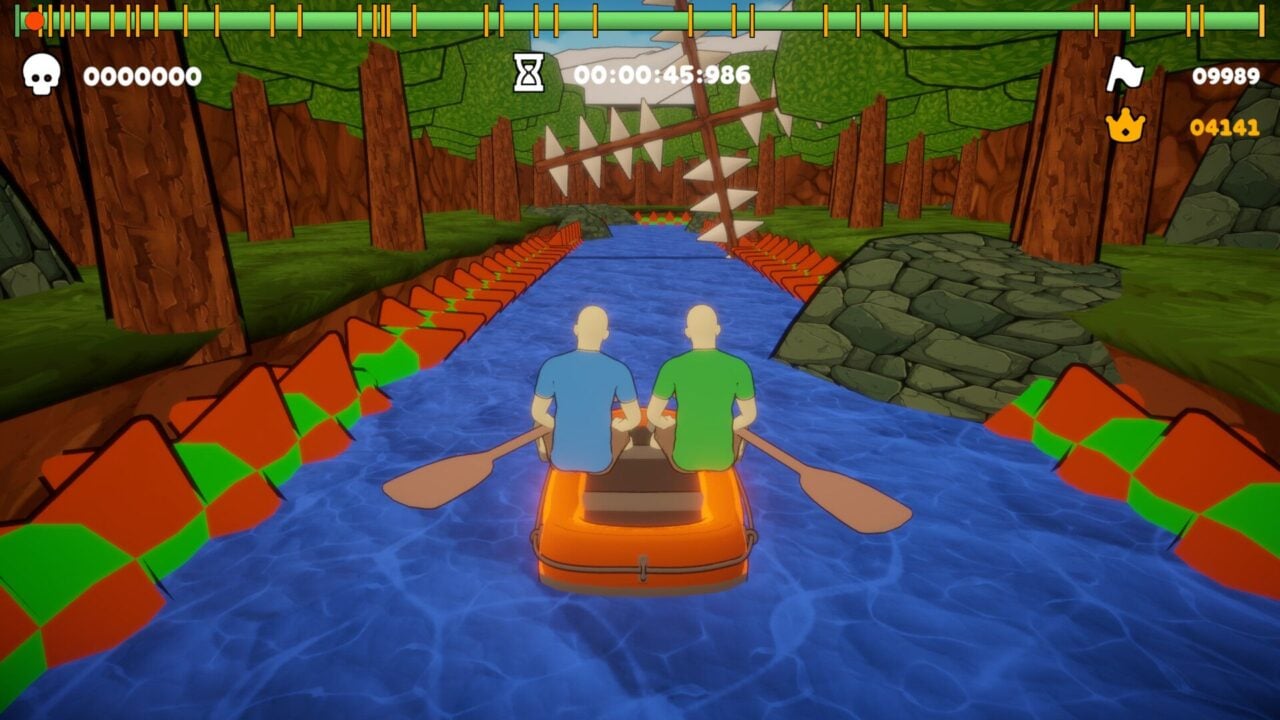
22-year-old solo game dev Zoroarts has created something of a break-out hit on Steam. Paddle Paddle Paddle, the designer’s second game (following 2023’s Makis Adventure), is a short third-person boat-paddling adventure played either solo or in co-op. And by the developer’s own report, it’s sold a very impressive 262,000 copies in its first year of release. However, 55,000 of these have been refunded via Steam’s no-questions policy, because the game can be completed in under two hours.
Valve’s refund policy on Steam is extremely consumer friendly. If you’ve owned a game for less than 14 days and played it for under two hours, then you can just get your money back without any further complications. As a player, this is great—spend $60 on a game, discover you absolutely hate it, and so long as you haven’t played it for a significant length of time, you can get a refund. However, if you’re a developer who’s made a game that’s shorter than two hours, it can be the worst.
“This should not be possible @Steam,” says Zoroarts on X. “Would be cool if you could finally do something about your refund policy.” He explains that he’s received dozens of reviews from players expressing how much they enjoyed the game but who refunded it anyway, adding that he’s received a “21% refund rate even though the reviews are 90% very positive.”
This should not be possible @Steam
Would be cool if you could finally do something about your refund policy… Got dozens of reviews like that and 21% refund rate even though the Reviews are 90% very positive…
Thats over 55,000 Refunds btw… pic.twitter.com/fSiuHjGRnD
— Zoroarts 🦈 Paddle Paddle Paddle OUT NOW (@Zoroarts) July 5, 2026
Paddle Paddle Paddle wasn’t intended to be shorter than two hours. Zoroarts had aimed for closer to three-and-a-half hours, and reports that the chaotic paddling sim takes many players about this long to complete. However, it’s also proven very popular among speedrunners and those who mainline games that are said to be extra-challenging, so it’s drawing in crowds who are racing through the game and hitting credits within the refund period. 55,000 of them, in fact.
The game costs only $5 at full price, and has routinely been on sale at $3 for large sections of the past year, making it all the more peculiar that people don’t think their positive experience was worth the price of a Starbucks coffee, not least when the game has 89-percent positive reviews on Steam. At an average price of $4, after Steam’s fee, that’s $154,000 in lost income (of which we can assume a significant amount goes to publisher Assemble.)
It does raise an important question for Valve, given how the policy so clearly discriminates against developers of short games. Although a solution is not obvious, we’ve reached out to Valve to ask if it’s a matter they’ve considered. Zoroarts’ suggestion is that expected playtimes could be displayed on the store page for a game, and then when that’s shown to be under two hours, “too short” could be removed as a refund reason.
We’ve also reached out to Zoroarts to ask more about his experience, and will add responses should they arrive.
About the Author


