

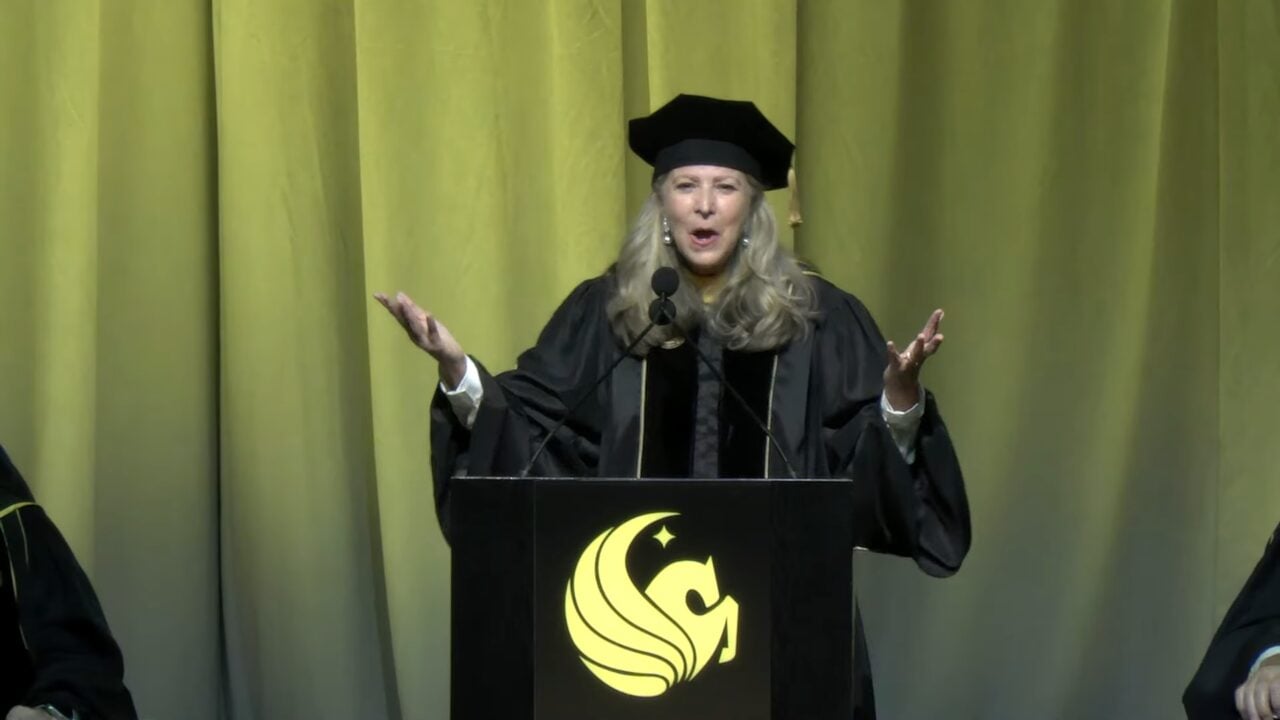
I don’t know the vetting processes universities go through when screening their graduation speakers. The U.S. has thousands of institutions of higher learning, and they all need someone to give a speech to inspire the youth each spring. The speaker for the University of Central Florida attempted to do just that, and it seemed to be going alright until she mentioned AI.
The University of Central Florida held its spring semester graduation ceremony on May 8, and it included a speech by businesswoman Gloria Caulfield, the Vice President of Strategic Alliances for real estate firm Tavistock Development Company, and the President of the Lake Nona Institute, a non-profit that “incubates, activates, and measures the impact of innovative technologies and programs that can become global models for building healthy, sustainable, and inspired communities.” According to her LinkedIn profile, Caulfield isn’t a UCF alumna, but is based in Florida. I guess proximity gets you in the door for these sorts of things, too.
Caulfield’s speech starts off simple enough. She thanks the University staff for having her and tells the graduates to take in the moment. Then it starts to get weird when she starts talking about how she has worked with some of the “most prolific leaders and innovators of our time.” These “leaders of significant accomplishments” include…Jeff Bezos, founder of Amazon and known ghoul.
But the backlash to her speech didn’t get loud until she called AI the “next Industrial Revolution”:
We are living in a time of profound change. That’s an understatement, right? Profound change. Change is exciting. Very exciting. And let’s face it, change can be daunting. The rise of artificial intelligence is the next Industrial Revolution.
This statement is immediately met with boos from the crowd, which seems to surprise Caulfield, because she turns to people on stage and asks “what happened?” When she continues, she says that “only a few years ago, AI was not a factor in our lives,” which is met with applause from the room. This, again, seems to boggle Caulfield’s mind, as she says AI seems to be a “bipolar” topic in the room.
People use “bipolar” as a way to describe what some view as an inconsistent response to something, but Caulfield fails to realize that booing the notion that technology is being used to replace human jobs and applauding that this was once not a concern for college kids who are about to head out into the workforce is actually very consistent. But she’s clearly frazzled that she’s lost the room so quickly, so I suppose her brain just picked the first word that came to mind.
She keeps going and says that AI capabilities are now in the palm of our hands, which, again, the kids boo. She commends this as “passion.” If I were in her shoes, I’d maybe start skipping ahead a few lines in my speech. But her entire thesis is that the job market has faced uncertainty before, and while the introduction of things like the internet was seeming scary at the time, they ultimately paved the way for new jobs in the future, so she ploughed through anyway.
The whole thing is an uncomfortable, but cathartic watch. You know these kids have come into university at the beginnings of the rise of AI and its known threat to jobs as penny-pinching corpos look for any way to cut costs for themselves at the expense of their workers’ livelihoods. What makes you think a graduation ceremony is the place to be glazing AI as the future?
It’s ghoulish, but Caulfield’s surprise is the kind of reaction you get when you’re completely disconnected from the fears and struggles of people being shoved out into an economy being taken over by AI. Nevertheless, Caulfield said on her Instagram account that the graduation ceremony was “an extraordinary evening it was to empower the next generation” and that she was “humbled” to be able to spend the night “igniting optimism and potential in our future leaders.” Okay, girl.
About the Author


