

Tim Schafer, head of Double Fine, didn’t really work much on Kiln. He was, as he says, “right next to it,” giving “ideas and stuff.” But apparently, he inadvertently gave the game its name, a fact he didn’t realize until he watched the Double Fine documentary on its internal game jam, Amnesia Fortnite. From it, Schafer unlocked his own memory of Kiln project lead Derek Brand pitching the game to him, and Schafer suggesting he call it Kiln, “like you’re killin’ it.”
“Smashing it” would probably be more accurate, but less punny, and we’ve already got a game with that name. In Kiln, you play as a little spirit that can inhabit and control pottery. In teams of four, you compete to quench the other team’s burning kiln by filling the pot you’re currently possessing with water and carting it over to dump on their kiln before they can do the same to yours.
Where Kiln gets fun and tricksy is in the pots themselves: you sculpt new pots between matches using an array of customization tools that grows the more you play, and the size and shape of your pots determines how effective you’ll be at certain tasks. Different-shaped pots will have different health pools and different water-carrying capacities, as well as different methods and speeds of attacking and breaking enemy pots. And you can set up to three pots on your “top shelf,” and swap between those three mid-match to meet the moment or balance out your teammates’ choices.
A tough pot to crack
Kiln’s been in development for nine years at Double Fine, ever since that fateful Amnesia Fortnite event. Schafer says the game’s concept was immediately compelling internally, because it had “a totally different energy than most of our games. Especially when you make narrative-based games, like you make Psychonauts, like the humor and stuff, no one’s laughing at the game after the fifth time they’ve wired up a cutscene, like no one is. But this game, people were hooting and hollering and playing it after the playtest was over for fun. No one plays adventure games for fun when they’re making them.”
The reason Kiln took so long, per Schafer, was partly that the team had to take a break to work on Psychonauts 2, but also partly that it was very, very hard to figure out how to make the shapes of the pots matter. “For a while I was like, it was fun for the game, the immediate version of it was fun. But eventually you stopped caring about what you’re making because it was all the same. You got to really make this shape thing matters. And for a long time, that was the big challenge is trying to figure out how to make shape matter. And that was the phrase that everyone hated. ‘Shape matters.’ But they really did it in the game. Really, when you play it now, it’s just like what I kind of hoped it would be, like you’re on the battlefield and you see an enemy use an attack you’re not familiar with. And then you have to figure out how they built that character, that shape, to get that power.”
“Shape matters” as a directive seems to have worked. Kiln encourages experimentation. While you can take a lot of time and effort to make an elaborate pot if you want, it’s actually very quick and easy to make a new pot just to try out a new combination of size, shape, and ability, which in turn makes me want to do it over and over again. After every match, you’re dropped in front of a bunch of pottery wheels in the game’s central hub, inviting you to sit and make a new pot before you head back into a new match. The actual act of making pots is fun, too—you control bare hands or various pottery tools using the buttons and sticks (or mouse) to mold and shape clay exactly the way you want.
The tools are surprisingly versatile. For instance, Schafer was using a series of pots shaped like donuts when we played together, having somehow managed to approximate a hole down the middle and decorate the tops like frosting. He says he only got it to look like that after he “worked it and worked it and worked it.” Then he did it two more times, making a small, medium, and large-sized donut that he says he’s using as a “psyop” to trick enemies into thinking they’re shrinking as the match goes on.
Schafer has also posted pots shaped like watermelons and eyeballs. But he especially loves it when fans share their pots. He tells me about how, during the development of Psychonauts, he was friends with folks at Media Molecule who were making LittleBigPlanet. “I was so jealous,” he says. “Like the first time I was really jealous of a game, because we had always made games that really were like, ‘look at all the creative stuff we can do.’ We’re sharing how creative we are. And they made a game that celebrated not their creativity, but the creativity of the players. And I was like, oh my God, that’s so much cooler.”
His favorite creation so far from another player, he says, is this Marge Simpson pot:
I’m not quite so visually creative, but it doesn’t matter. Kiln keeps the pottery aspect interesting by continually sprinkling you with new toys to play with: new pottery tools for shaping, new glazes for coloring, new stickers and handles and spouts and lids. Even when I had a top shelf of three pots I was happy with, I kept going back to the wheel to make more, just to see what I could come up with. I’m still unlocking things, but my current top shelf looks like this.
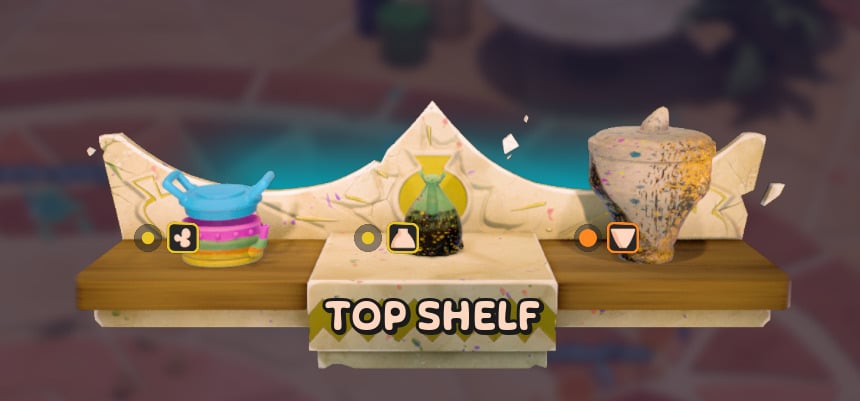
As you can see, I’m still working out the best way to glaze my pots. I’ve gotten really into small pots since I unlocked them, but I’m really stoked to unlock large ones in just one more level. The wildest match I’ve had so far involved one of my opponents in an absolutely massive pot posting up at a choke point in Athena’s War Room and smashing the crap out of any opponent who came in or out. The choke point was the entrance and exit of both sides’ kilns, so they could easily slip onto either side and defend the home kiln, or protect teammates trying to douse ours. We lost, but my team’s frantic strategizing to figure out how to get past the big boy was a major highlight.
At the moment, Kiln is a fun romp. The meanest thing I can say about it, apart from the fact that it runs just a little funky on the Series S (Schafer accepted the feedback, saying they’re still optimizing), is that there really are only the two things to do: make pots, quench, repeat. There are six different maps, and the maps are genuinely distinct in fun ways, such as Set’s Basement Mosh Pit featuring a dance floor that sinks into the ground and traps you in it while it fills with water, or that aforementioned choke point in War Room.
Kiln‘s journey isn’t over yet
But within a few hours I had the gist of all of Kiln. Schafer says Double Fine doesn’t “quite” see Kiln as a live-service game, but there are updates on the way: Double Fine just released a new map today (the game launched with five), two more maps are planned for the summer, and more stickers and other cosmetic add-ons are coming in future weeks. He’s apologetic about the lack of local multiplayer: “That was one of the dreams,” he says when I ask. “Just, I think, dev time of doing split-screen and stuff. You know, it’s a really small team and we wanted to get it out.” After nine years in development, understandable.
Schafer also casually drops that the team is “coming up with new game modes and stuff.” He doesn’t elaborate further there, but to me, that’s perhaps the biggest thing Kiln wants at the moment, is another way to play and another reason to make different kinds of pots. He encourages fans not just to share their pots on social media but also to offer more game mode suggestions in the game’s official Discord server, suggesting they’re taking feedback on that front seriously. Kiln, he says, still has all the same developers working on it now that were working on it up to release, implying a commitment to keeping the fire burning for the time being.
Schafer seems especially happy with that, particularly since Kiln was a breakout project for a number of longtime Double Fine devs. “I feel like everyone on the team learned so much,” he says. “Because a lot of people on the team, this is their first time doing that job. Like, Derek was a first-time project leader. The lead programmer, lead designer, it was all their first time. They learned so much and, like, leveled up so much in the process of making this game.”
Kiln launched back-to-back with last year’s Keeper, a very sweet and weird and similarly small-in-scope game about a lighthouse with legs. I remark that I’m appreciative of Double Fine having been able to, thus far, keep making smaller, off-beat games like this even post-Microsoft acquisition, in spite of the many, many changes at the company since. And it sounds like Double Fine has kept its owners reasonably happy even in that smallness. “It’s nice that Microsoft is like, the fact that Matt Booty always mentions our games whenever he does an all-hands meeting,” Schafer says. “I was like, I wonder why they’re buying us, because we’re so little. And I think it does matter to him that Microsoft, you know, visibly supports games like Kiln and Keeper.”
Together, Schafer and I play three matches. We lose two and win one. He shows me a shortcut I hadn’t seen before on the Mosh Pit stage, and offers some tips on glazing my pots. In the match we win, Schafer and I clench it with back-to-back super splashes on the enemy kiln. I could have kept playing. I want to unlock those big-sized pots, and I just got a cool new glaze patterned with roses that I want to make something out of.
But Schafer has to go. “I gotta go to stand-ups on my cool new secret game,” he says casually. He is, obviously, keeping the lid firmly on whatever that is.
About the Author


