

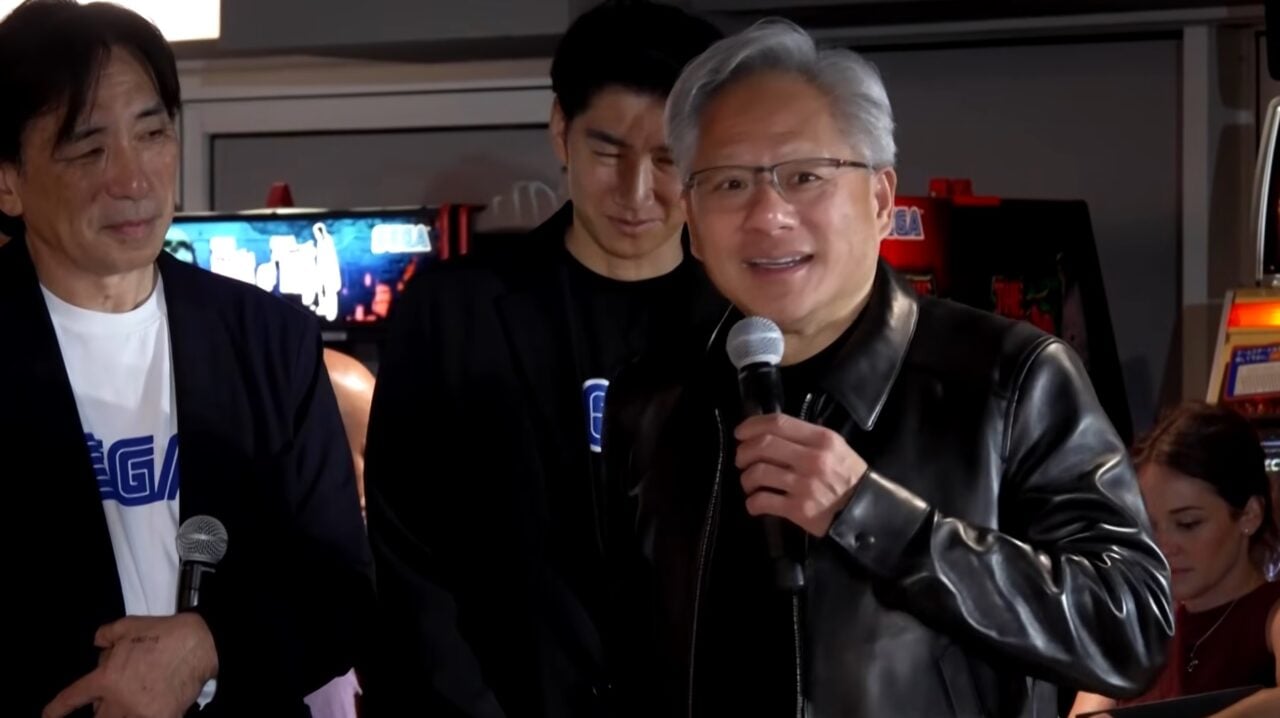
Nvidia CEO Jensen Huang joined Sega’s leadership, including its former president, in a Tokyo arcade on Wednesday to celebrate an important partnership between the two companies that proved integral to the graphics chip maker’s later success. It was a fascinating moment that called back to the complex histories of both companies, but it also comes as Nvidia is currently blowing up the video game industry Sega depends on to survive, as the AI race fuels price spikes on hardware.
“If not for what Sega did for Nvidia and what I Irimajiri-san did for Nvidia, Nvidia would not be here today,” Huang said during the visit today. He continued, “To imagine that in 1995, Nvidia was nearly out of business, that we had chosen exactly the wrong technology, and that we will be here today, the largest company in the world, is unimaginable.”
Nvidia’s initial graphics technology in the ’90s lost out when Microsoft announced DirectX would not support it. It then failed to win a contract to manufacture the processor for Sega’s Dreamcast. Despite ultimately being rejected by Sega, however, its president at the time, Shoichiro Irimajiri, moved forward with a $5 million bet on the small startup. It was enough to save Nvidia’s fortunes, and the company later launched GeForce 256 and was eventually contracted to help with Microsoft’s Xbox.
Sega reportedly sold its stake in Nvidia for $15 million. Were it sold today, it would have netted over a trillion. “I hope that everyone at Sega will be as proud as we are of the history of this collaboration between Nvidia and Sega that continues to this day,” Huang said, via VGC. “It is truly wonderful.”
Fast-forward to nearly three decades later, and Nvidia is currently helping to transform gaming by fueling an AI arms race between competing LLM models and data center hyperscalers like Microsoft and Google. Ramping up the controversial technology requires an endless supply of chips, which in turn require RAM. The unprecedented shortage of that component is leading to a slow-burn reckoning across gaming as console makers and PC hardware sellers grapple with spiking prices.
As the price of RAM doubles, console makers like Nintendo and Microsoft are feeling the pressure. The former lowered shipment forecasts for this upcoming year, and leadership at Xbox has already loudly complained about the challenges of delivering next-gen gaming hardware that’s still affordable. Sega no longer makes a console. The Dreamcast that Nvidia lost the bid for was the Sonic publisher’s last. But it relies on that ecosystem as much as anyone, and it’s less clear than ever how it will look in five years.
About the Author


