

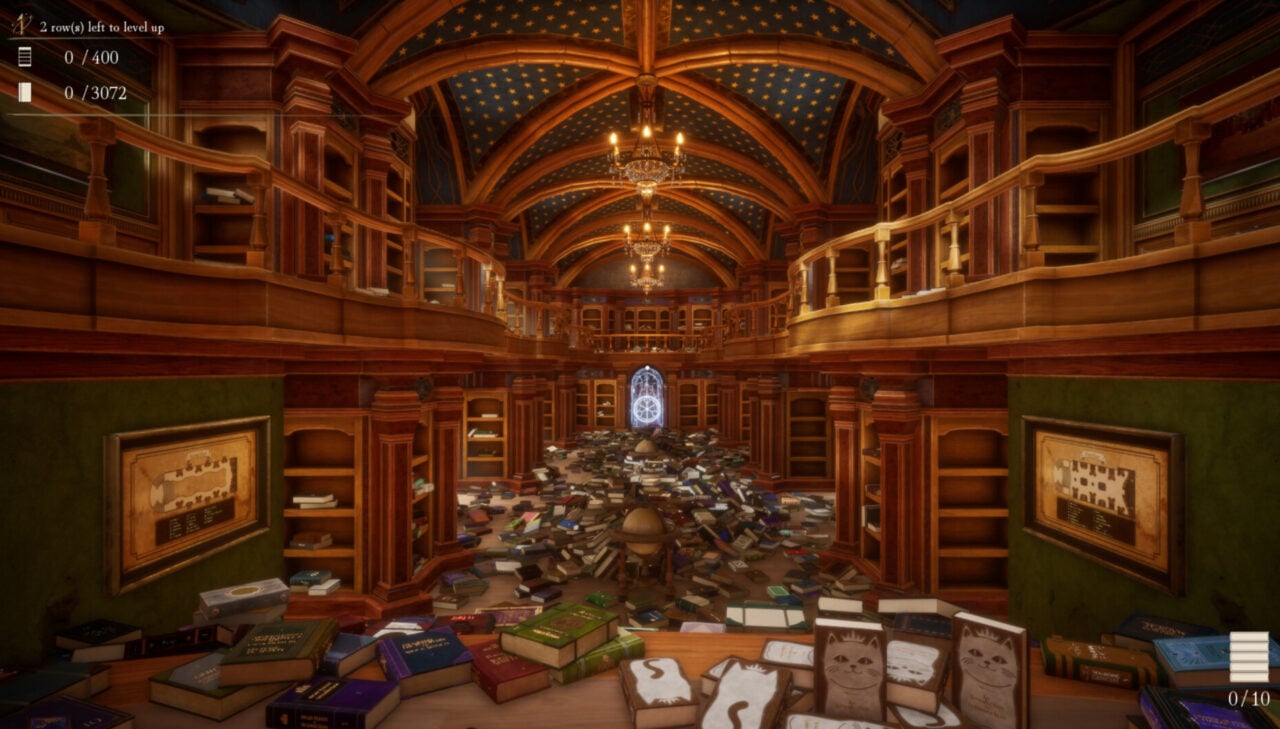
Around the start of May, a cozy game called Librarian: Tidy Up the Arcane Library! began to slowly make its way up the Twitch charts. In Librarian, you’re tasked with organizing a whopping 3,072 books haphazardly strewn across a fantastical library’s floor. It’s definitely a tedious process a la PowerWash Simulator, but you eventually unlock magical abilities that make things easier, which have sparked plenty of speedruns and casual streams alike.
People love Librarian: Tidy Up the Arcane Library! A little over a week ago, it hit 29,000 concurrent players, which is pretty impressive considering the fact that it was developed by an indie team of only two people under the name ArtRising.
There’s one caveat with this game, though, and it’s buried at the veeeeery bottom of its Steam page: its developers used a bit of generative AI for asset refinement and grammatical corrections. In the weeks since its release, the game has spawned negative reviews, requests for AI-free alternatives, and heated debates over the ethics of playing a game developed with just a little bit of generative AI. A few streamers who were set to pick up the game even cancelled their streams after finding out it was made with AI:
I did NOT in fact read.
My stand on AI has been very clear and I will not support it in any way, big or small. I will be cancelling the stream, issue a refund and plan something for tomorrow.
Sorry. https://t.co/JOb08YTZT5— Janken Pomme👊🍎 (@JankenPomme) June 2, 2026
All of this backlash was spawned by just four in-game assets and some grammatical corrections, according to the Steam page’s disclosure:
The four assets in this work—one UI component and three landscape paintings used as wall decorations (frames not included)—were produced using additional AI for refinement. None of them were created by AI from the ground up.
AI helped with grammatical corrections for in-game text, which were then carefully reviewed and adjusted by hand.
We only consider AI to be a supportive tool. Every detail is meticulously crafted with human intent, as our creative process is still firmly anchored in manual craftsmanship.
However, a small handful of Steam reviewers have disagreed with the game’s AI note, mentioning that they believe AI was used further without proper disclosure.
“First up, I absolutely do not believe the disclosure of GenAI used in this game,” one reviewer wrote. “I spent hours picking up books and reading titles, and I do not believe for a second that all of the covers and titles were crafted by people.”
“i believe that there was more AI used than disclosed for things that could have somewhat easily been done by actual people,” another player wrote.
For the most part, though, players seem generally okay with Librarian’s AI usage. Plenty of people are still playing it. The game’s reviews are still ranked as “Very Positive” on Steam (a few praise the gameplay while casually disapproving of its AI-enhanced content). Even Aftermath, which sells shirts that say “DESTROY AI,” published some favorable words about it.
I’ve had trouble reckoning with this game myself. As a Tiny Bookshop devotee and a former real-life bookseller, Librarian is right up my alley! I would love to play it, and it seems like a great game. I’ve admittedly jumped over to its Steam page a few times and considered buying it, but I’ve ultimately held off. It just feels so difficult for me to justify playing anything made with generative AI—if Librarian continues to do well without replacing its AI assets, other devs in the cozy sphere might take the game’s success as a green light to kick their own AI use up a notch.
Librarian’s use of AI is especially puzzling to me because, if the Steam page really does disclose all of its AI use, it would be incredibly easy for the devs to replace those AI assets (just one UI component and three landscape paintings). Even just stock images, barebones programmer art, or MS Paint drawings that say “placeholder” in Comic Sans would be a step up!
About the Author


