

While this year’s Anime Expo was awash with big announcements regarding sequels to certain beloved shows and creatives reminiscing on the legacy of popular franchises, some of the weekend’s most fascinating announcements were secretly nestled away in a panel centered around Yoshitaka Amano, well known for his artistic contributions to franchises such as Final Fantasy.
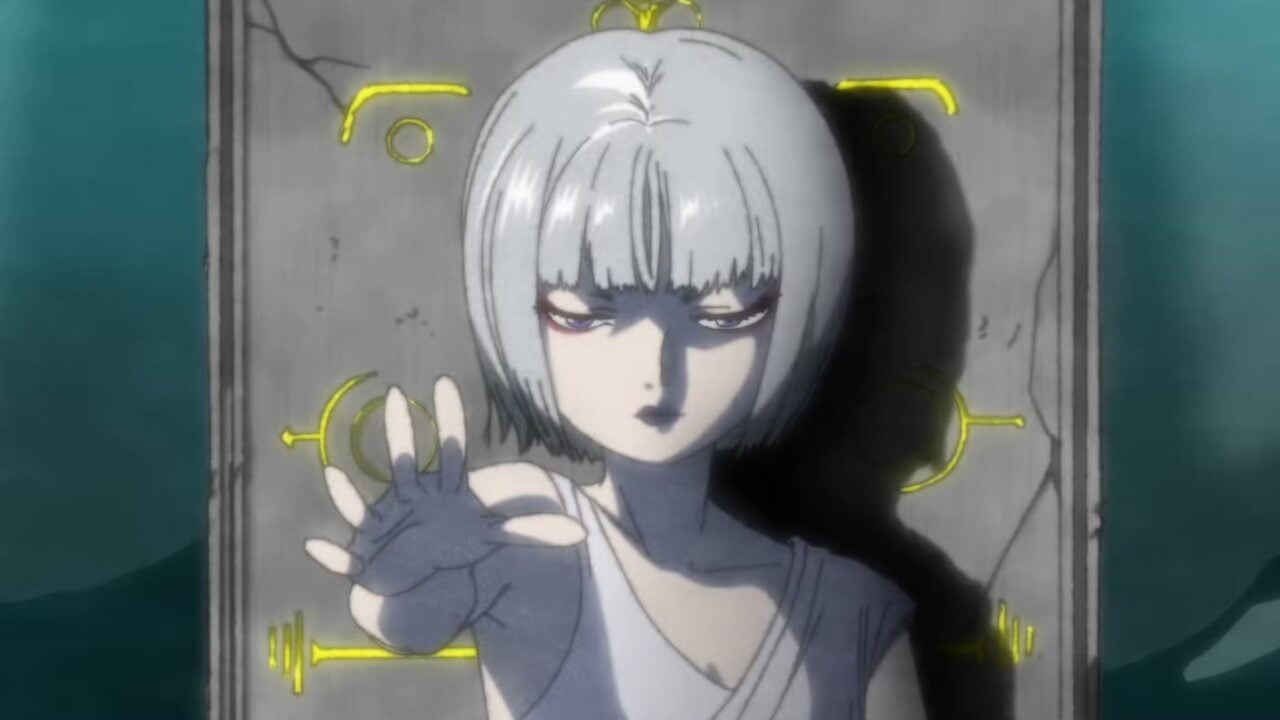
The first of these announcements was the formal showcase of ZAN, an anime adaptation of an artbook that Amano published under Dark Horse Comics in 2013, and which is billed as “a thrilling sci-fi action fantasy that crosses time and space, woven with stylish heroes and an exhilarating storyline.” Across both the Anime Expo panel itself and my interview with Amano afterwards, special emphasis was placed on the usage of hand-drawn art, on paper, for the production of this new limited series.
The series’ staff includes industry veterans such as directors of animation Masashi Ikeda (Inuyasha, Gundam Wing) and Toru Yoshida (Armored Trooper VOTOMS, Gundam SEED), Principal Animator Moriyasu Taniguchi (VOTOMS, Samurai Champloo), writer Yuya Takashima (Mobile Suit Gundam: The Witch from Mercury, The Fable), and art directors Kunio Ogawara (Time Bokan, Mobile Suit Gundam) and Minoru Nishida (Kill Bill, Doraemon: Nobita’s Dinosaur 2006).
During the panel, special mention was made of the staff’s combined age and experience, with some members over 80 years old, and in fact the average age eclipsing 60. Alongside the introduction of many of the staff, the team showcased a short “pilot film” for the series, and noted that every frame was hand-drawn on paper before being digitally scanned. It’s a short teaser film, only about 90 seconds long—and the team mentioned that they were still making edits to it the night before the panel—but even without any sort of plot, the visuals have their own unique flair.
Following the pilot film was the announcement of a Los Angeles–based studio for Yoshitaka Amano Inc., a production company intended to “develop Yoshitaka Amano’s IP into a fully scaled international brand.” Hidden within the press release for the studio was the reveal that not only is the ZAN animated series intended for a 2028 or later release, but development of two more unannounced animated productions is also on the way.
Needless to say, I had a few questions—and were fortunate enough to have the chance to speak with Amano ourselves to get some answers. The obvious first question is, with such a heavy emphasis on human-drawn art, why the decision to start a production company now?
“For myself, this is really nothing new. When I started at Tatsunoko, you know, everything was hand drawn.” Speaking through an interpreter, Amano explained that for him animation is, and always has been, the ability to hand-draw your art.
“You have some people now who are working on anime, and even manga projects, and when they’re given a Shikishi board for them to draw something on, they can’t do it. It’s because they’re so separated; they’ve become so decoupled from the actual artistic process themselves. All they can do is sign their name, and that—preserving the idea of people drawing things—that’s what it all comes down to.”
For Amano and his team, the process of creating ZAN has been a passion project from the very start. During the panel it was even mentioned that some of the animators have filled their homes with so many drawings that the only clean space in their house is their bed. The 90-second pilot film alone included 2,700 pieces of hand-drawn art. That kind of passion comes from the desire to not just create, but to pass their passion downstream to the next generation as well.
“Like, in 100 years, [ZAN will] have to be that guidance. Because you have kids now that are already asking, ‘How do you make art like this? How do you draw so well?’” The answer Amano gives to that is, of course, rather simple.
“You have to sit down and actually draw.”
Taking a step back from ZAN and the philosophies behind the project, I turned to the LA-based production company. How did Yoshitaka Amano decide he wanted to work in Los Angeles, California? The answer, too, was surprisingly simple.
“We went to the Santa Monica Pier, three years ago, after Anime Expo. I loved the weather, and I just decided—’I want our studio to be here.’ If I hadn’t come to Anime Expo back then, it might not have even happened.”
Of course there’s a little bit more to the story than that, including an acknowledgement that Amano has many fans and potential collaborators around the LA area. More than just an impulsive decision, it was what felt right for the company. Announcing this was the easy part for Amano and his team; what comes next is the real challenge, and will determine how well the team can preserve the process of hand-drawn art into the future.
“I’ve said it now, and breathed it into existence. Everything we talked about today—It’s my job to follow through and make sure it happens.”
About the Author


